



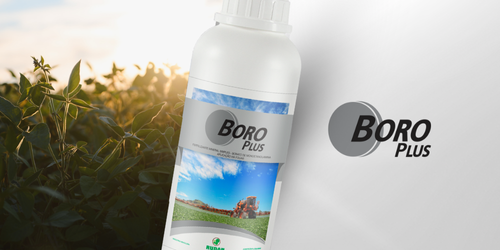
Boron is one of the most important micronutrients for plant development — and also one of the easiest to lose in the soil due to chemical binding and leaching. That’s why choosing the right source makes all the difference in ensuring productivity, vigor, and proper grain formation.
But what exactly are the differences between the boron sources available on the market? And why is Rudan’s Boro Plus a superior option?
Today, several boron sources are available: octaborate, pentaborate, tetraborate, boric acid, and monoethanolamine borate — the technology used in Rudan’s Boro Plus.
Each source has chemical characteristics that directly affect plant absorption and soil retention.
It Has low foliar absorption and high loss in the soil. Because it carries a negative charge, it binds to positively charged nutrients (such as calcium, magnesium, and sulfur), reducing its availability to the plant.
Features a molecular protection technology that neutralizes its electrical charge, making it neither positive nor negative. This prevents unwanted chemical interactions in the soil and increases absorption efficiency both through the leaves and the soil.
Rudan’s exclusive Boro Plus technology ensures:
This means the applied boron reaches from the roots all the way to the flag leaf, providing complete and uniform nutrition.
Approximately 80% to 90% of Brazilian soils are boron deficient.
Besides being easily leached by rain, boron is also one of the micronutrients most exported by grains: around 30% of all boron absorbed by the plant goes into the grain, which is removed from the field at harvest.
For this reason, annual replenishment is essential to maintain soil nutritional balance and prevent drops in productivity.
There are two main application strategies:
Recommended to increase boron levels in the soil, improving nutrient availability throughout the crop cycle.
Used to supply immediate plant demands, supporting the development of the current crop.
To correctly assess the need for boron correction, chemical and physical soil analysis — including micronutrients — is always recommended.
Boron plays several essential roles:
A plant properly supplied with boron is healthier, more productive, and more resilient.
When properly managed, the ideal boron level in the soil should be above 1 mg/dm³.
However, in Brazil, the national average is still low — between 0.2 and 0.3 mg/dm³.
With annual applications and the use of high-efficiency sources such as Boro Plus, it is possible to raise this level to the ideal range within a few years, ensuring better rooting, flowering, and overall productivity.
Rudan’s Boro Plus is more than just a boron source — it is an intelligent nutritional technology that provides:
With Boro Plus, the farmer achieves better results in the field, higher productivity, and more balanced soil year after year